How to Navigate Major European Train Stations Like a Pro
Share
Master complex transfers in Paris, Berlin, and Milan without the stress.
The Intimidation Factor
Major European train stations like Paris Gare du Nord, Berlin Hauptbahnhof, or Milano Centrale can be overwhelming. They are massive, multi-level complexes filled with thousands of rushing commuters, confusing signage, and numerous platforms. But with a bit of preparation, you can navigate them smoothly.
Berlin Hauptbahnhof: The Multi-Level Maze
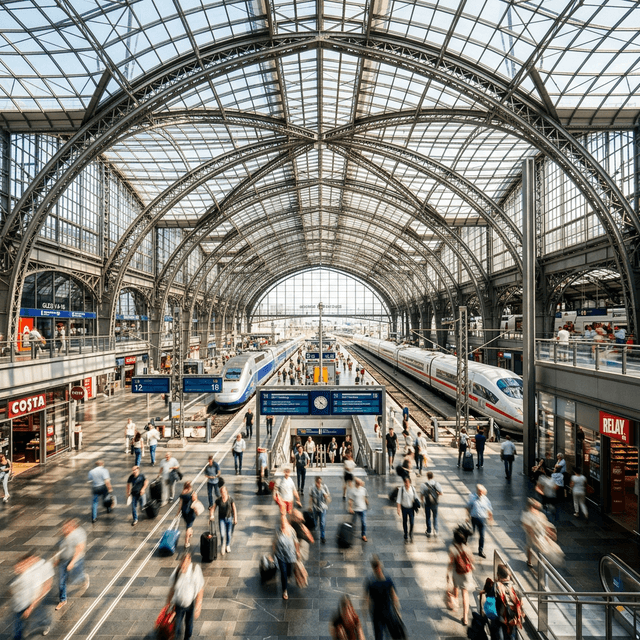
Berlin Hbf is an architectural marvel of glass and steel, spanning five levels. The key to surviving here is knowing your track number (Gleis). High-speed and intercity trains usually depart from the lowest level (Tracks 1-8), while regional trains and the S-Bahn operate on the top level (Tracks 11-16). Give yourself at least 15 minutes to transfer, as the elevators can be slow and the escalators are long.
Paris: Navigating Between Stations
Unlike Berlin, Paris doesn’t have one central station. It has six major terminuses. If your journey requires a transfer through Paris (e.g., traveling from London via Gare du Nord to the South of France via Gare de Lyon), you will need to take the Metro or RER. Buy a Metro ticket in advance if possible (e.g., in the buffet car of the Eurostar) to avoid massive queues at Gare du Nord. Allow an absolute minimum of 60 minutes for any cross-Paris transfer.
Milano Centrale: Beauty and Chaos
Milano Centrale is stunningly beautiful but famously chaotic. The platforms are all on the upper level. Pay close attention to the electronic departure boards. In Italy, your specific platform number is often only announced 10-15 minutes before departure, which causes a sudden stampede of passengers. Keep a close eye on your belongings in crowded areas and ignore anyone offering 'help' with ticketing or baggage.
Golden Rules for Station Transfers
Always download the national railway app (e.g., DB Navigator, SNCF Connect) for live platform updates. Look for the yellow departure posters (often called 'Abfahrt' in Germany or 'Départs' in France) if the electronic boards fail. Above all, build buffer time into your itinerary—a 10-minute connection might be mathematically possible, but a 30-minute connection significantly lowers your stress levels.
Ready to start your journey?
Get the best prices for train tickets across Europe with our independent price comparison platform.